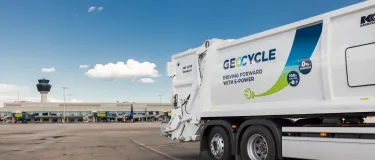
Recycling is taking off at Athens International Airport
Picture this. You’re at the airport, ready to jet off on your vacation. You grab a sandwich to eat at the gate, toss the packaging in the trash and it’s time to board. Now imagine millions of people doing this same thing each year. Have you ever thought about how much waste that generates?
As one of Europe’s busiest airports, Athens International Airport (AIA) has a huge amount of waste to manage. That’s why the AIA team is doubling its efforts to increase recycling and minimize the airport’s environmental footprint.
We sat down with Michael O’Connor, Manager of the Environmental Services Department at AIA, to discuss how he’s working with Geocycle to improve the airport’s waste management.
Why is waste management such a challenge at Athens International Airport?
To start, it’s worth taking into consideration that an airport is essentially a small city. At AIA, we employ over 17,000 people across the 300 companies operating here, and it’s not only cargo and airline companies. We have food, beverage and retail shops, along with our commercial park and expo center. This doesn’t even account for the millions of passengers that pass through on a daily basis. All of this means we produce over 20,000 tons of waste per year. That is about 60 tons per day, approximately the weight of 10 adult elephants.
In residential areas and communities, the local authority is the one responsible for organizing the collection of waste. But at AIA, it’s the responsibility of the airport to manage the pick-up and disposal of all of the waste produced inside the airport fence.

How does Geocycle support you with waste management and recycling?
The airport runs on a 24/7 schedule, and our goal is to minimize any interruptions to operations as much as possible. Not to mention, we need to provide the highest level of service to the passengers passing through. But handling almost 60 tons of waste per day is no small feat. We needed a company with the expertise, infrastructure and trained personnel to manage non-hazardous mixed waste on our behalf – Geocycle was the perfect fit.
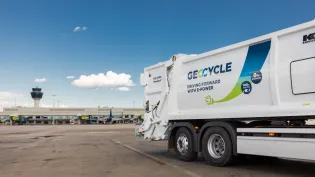
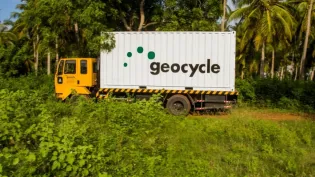
Geocycle provides a team of staff and equipment, including containers, bins and a fleet of vehicles. We trust its team to circulate throughout the 16 km2 airport to collect waste from different locations and transport it to their off-site sorting facility. There, Geocycle can extract additional recyclable materials from the waste stream that were improperly thrown away to help us achieve even higher recycling rates.
To further minimize waste, how are you encouraging recycling at the airport?

When the airport opened in 2001, the recycling rate was approximately 3%, with the rest of the waste heading to landfill. Since then, we’ve managed to increase our recycling rate to over 70%.
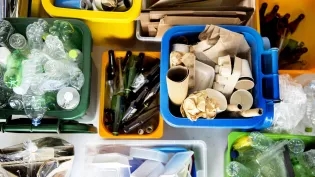
One of the ways we achieved this was to initiate financial incentives for the companies at the airport to encourage them to recycle more. We follow the Polluter Pays principle, meaning that any companies that produce garbage have to pay for waste management services. However, if a company goes to the trouble of recycling and separating their paper and plastic, we give them money back.
Our efforts extend to both our employees and passengers as well. To try to encourage recycling and other environmentally conscious behavior, we launched several awareness campaigns. For the airport staff, we conduct regular audits and training to ensure that waste collection and recycling are being done according to our set procedures.
What does the future of this collaboration with Geocycle look like?
Geocycle is really helping AIA move towards a more circular waste management model. That means reducing the amount of waste we send to landfill.
In 2024, AIA was awarded the Zero Waste to Landfill certification for the first time, based on our waste management and recycling data from the previous year. Of the total amount of waste that the airport produced in 2023, we managed to recycle 88% of it with Geocycle’s support. This is an incredible amount and helps us meet our objective to operate the airport in an environmentally sustainable manner.
Our biggest challenge at the moment is our upcoming expansion to be able to serve 40 million passengers by 2032. This will include an upgraded main terminal building, satellite building, new parking spaces for aircrafts and a multi-story parking garage. The expansion will create many environmental challenges, including waste management, so we will be relying heavily on Geocycle to see how we can best handle it over the next six to seven years.
We are really looking forward to continuing our collaboration with Geocycle and working towards increasing our recycling rate to 100%. That’s the ultimate goal!
Our Stories